On captions
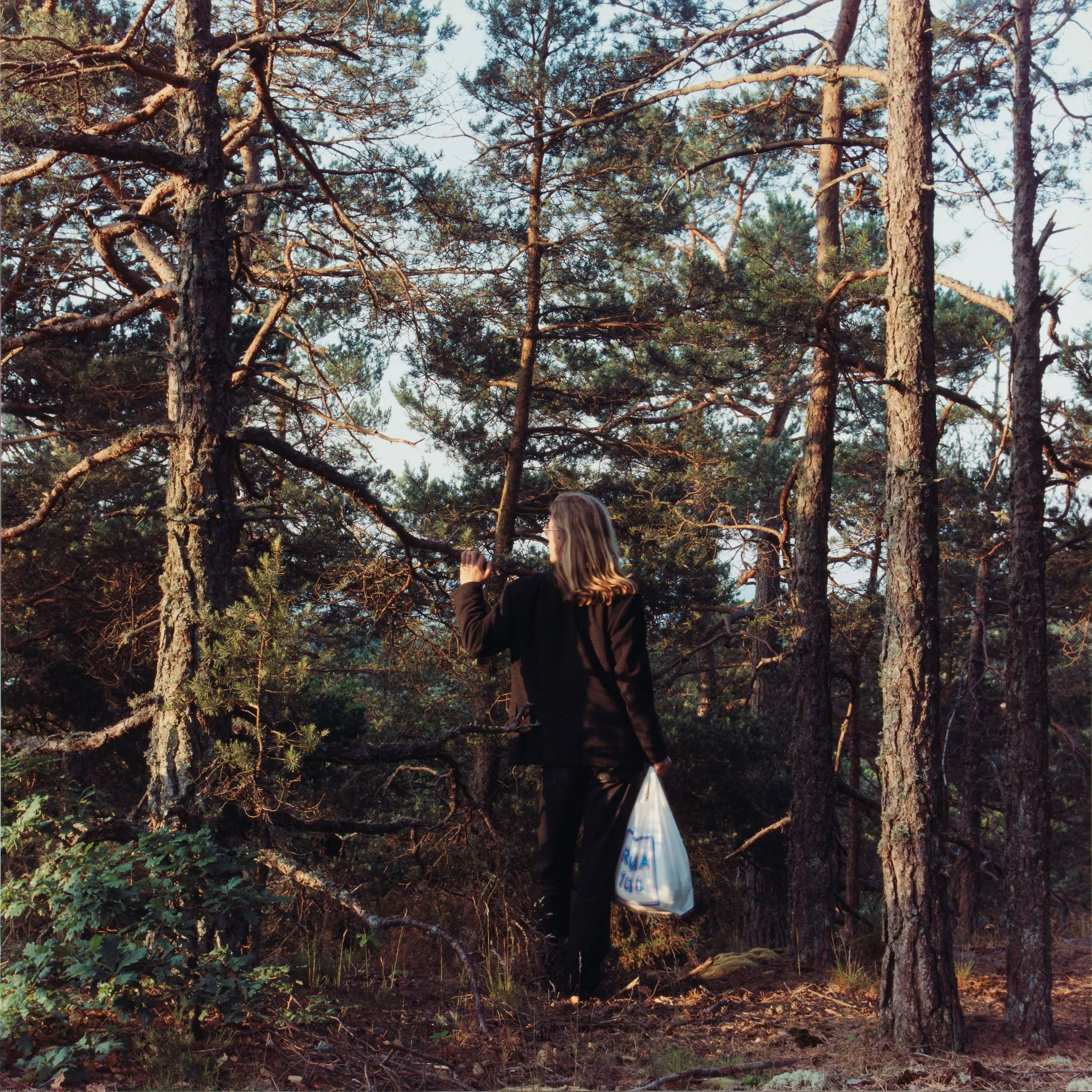
Torbjørn Rødland, In a Norwegian Landscape (6), 1993.
On my mind: Rødland and his plastic bag in a Norwegian landscape, encountered again while scrolling through the National Museum’s Instagram. The caption reads: He is being ironic about classical-romantic landscape art and the Norwegian sense of self tied to nature. And also: The shopping bag makes the break with the romantic clear. Thank you very much for leaving no room for any other interpretation of the work.
In photography’s bicentennial year, we are unlikely to see a shift in photography in Norway as significant as the one we witnessed in the ’90s with the ‘Bergen school’ of which Rødland was a part. That kind of revolution won’t appear among practitioners today, and it isn’t needed. Photography is art. There is nothing more to discuss. What I could revolt against, however, is the way we write about art, as exemplified by this caption.
I am thinking of a recent debate about a podcast on the museum’s website, in which two self-proclaimed amateur art lovers—a comedian and a chemist—went room by room through the newly built museum. A colleague argued that only in the arts is a lack of qualifications treated as a qualification in itself. Our confidence in people’s ability to understand art in Norway has always been low. Consider the old ’90s advertisement for the former Museum of Contemporary Art: Is this art or baloney? This from a museum that should definitely know what art is, and should be able to tell us.
The debate I mentioned took place on our national broadcaster, whose own recent forays into art programming have followed the same premise. The series Thomas og den vanskelige kunsten (Thomas and the Difficult Art), in which an ‘ordinary’ guy tries to understand challenging contemporary art, is an example. The word difficult tells us that we won’t understand—as if we were wandering cluelessly through a Norwegian landscape.
Rødland trusted us to understand. It is about time the institutions did, too.